Showing all newswire headlines
View by date, instead?« Previous ( 1 ...
5965
5966
5967
5968
5969
5970
5971
5972
5973
5974
5975
... 7359
) Next »
In the past, I have been particularly hard on KINO and its choice of UI schemes. However, one thing I really appreciate is despite KDENLive 0.4 and 0.5/0.6 crashes and other mindless anomalies, it works.
On November 19, 2007, we sent a second letter to IBM where we insisted on implementing the stipulations contained in this petition because we believe that OS/2 is an important part of the history of the Operating System, and furthermore, it still contains values that the computer science field considers unique.
I just finished taking the latest version of Puppy Linux for a spin and was planning on doing a review. However, considering this was on my notebook, that meant connecting to the Internet, preferably via wireless.
Everex plans to introduce a competitor to Asus's Eee PC at the beginning of next year. The laptop will run the gOS, an Ubuntu-based Linux distribution, cost $400, and have a 7" screen that might even be a touch screen eventually.
This article provides guidance to DCE or DFS users who are
migrating from DCE or DFS to Kerberos/NFS V4. During the transition period, these users need to be authenticated and authorized to use both DFS and NFS V4 directories. This article answers some basic questions, such as, "Can the DCE authentication server be used as a Kerberos server for NFS V4 with a Kerberos client?"
For months, I've been trying to get Microsoft to answer a few questions about the Unix technologies in its intellectual property portfolio. Microsoft agreed to an interview, then backed out. So the question remains: How much Unix code does Microsoft have its hands on?
Join the grassroots campaign to raise the awareness of all elected officials in Ontario!
We discovered back in September when running the Razer Barracuda AC-1 with ALSA 1.0.15 that this sound card was quite problematic with the initial CMI8788 ALSA driver. However, last month we reported that the driver was being rewritten from scratch with a much brighter outlook. We have retested the Barracuda AC-1 with its C-Media CMI8788 Oxygen APU using the latest snd-oxygen driver, which also works with other high-end sound cards such as the ASUS Xonar and Auzentech X-Meridian.
Discover an ontology toolkit for storage, manipulation, query, and inference of ontologies and corresponding instances.
IBM Integrated Ontology Development Toolkit includes EMF (Eclipse Modeling Framework) Ontolgy Definition Metamodel, and an OWL Ontology Repository (named SOR).
It's good news, bad news situation when it comes to Adobe's new Flash player for Linux. On the plus side, Adobe Flash Player 9 Update 3, version identifier 9.0.115.0 was made available for Linux at the same time as Mac and Windows versions. It's nice to see Linux not being treated as the little brother who only gets the older, hand-me down programs by a major software vendor. An even bigger win for Flash Player users, regardless of their operating system, is that its supports H.264.
Everex has confirmed plans to ship a UMPC (ultra-mobile PC) with a 7-inch screen, similar to competitor Asus's EEE PC. A source close to the company revealed that the device -- codenamed "Cloudbook" -- will ship with the Google Apps-oriented "gOS" Linux distribution early next year.
Nemo is the latest effort to provide a new paradigm for file managers. Its approach, at least in its first early development release, is to combine file management with calendar views. Questions remain, however, about whether the concept will scale, and whether it is an improvement on traditional file managers, or simply different.
Three cheers for the developers and management of the K Desktop Environment. They have taken a principled stand on the divisive issue of OOXML, the Microsoft Office Open XML document format. And for this the KDE folk deserve a round of applause.
Those who have experienced free software projects firsthand know that they depend on innovation and genrally foster it. And although this isn't a highly innovative era for the computer industry as a whole, free software is an exception--and likely to become more of one as it continues to come into its own. In fact, the very idea of free software is one of the most innovative ideas in the history of computing.
OpenOffice is the darling of the FOSS office suites, and it is a nice suite. It's cross-platform, and OpenOffice Writer is a first-rate word processor with a lot of advanced features. But it's not the only good option for Linux users: Abiword and KWord are excellent lightweight word processors with good feature sets, and both are licensed under the GPL. All three are wonderful. In this two-part series we're going to dig into KWord 1.6, and mine some of its hidden jewels.
Sysreport is a diagnostic utility. It collects information about the running system, which is used for Red Hat Support to analyze current problems with the system. While sysreport is generally considered non-invasive, diagnostic utilities should always be run with caution.
 LXer Feature: 10-Dec-2007
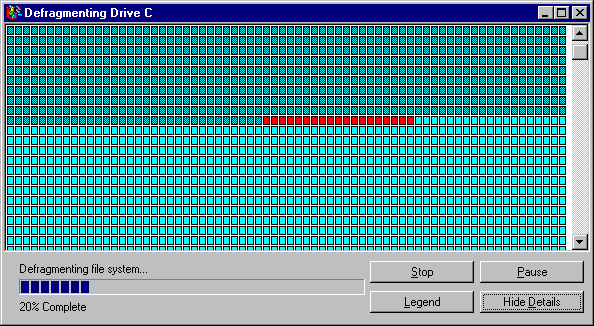
 Back in 1999 I remember the first PC entered our house coming preloaded with Windows 98. One of the things I liked about it was the
defragmentation screen where blocks presenting 'datablocks' on the harddrive were moving over the screen for almost eternally. I remember at that time it seemed like a logical maintenance requirement for any filesystem.
However, when I started using Linux four years later, I was told that with Linux I didn't need to defragment my filesystems anymore, since Linux filesystems don't get fragmented in first place. At that time it left me puzzled, but after a few years of using Linux without defragmenting my filesystems - and without any problems! - it seemed defragmentation was something antique. Nonetheless I still wondered how on earth it was possible the 100k+ files in Gentoo's portage system - updated every time I synchronize the portage tree - didn't fragment my filesystem. Or was my filesystem fragmented and did I not know?
Only recently, I found a script that is actually able to put numbers to all this gut-feelings, and the results were quite surprising in my opinion.
The Linux Phone Standards (LiPS) Forum has announced the completion of the LiPS Release 1.0 specifications, aimed at setting up interoperable standards for the development of applications on Linux-based cellphones.
"That is why Microsoft is handing out $100m checks to studios just embrace the HD DVD and not the leading, and superior Blu-ray," he continued. "They want confusion in the market until they perfect the digital downloads. Time will tell and you will see the truth."
SourceForge has launched a free online marketplace for buying and selling service and support for open source software (OSS). Building on its well-established position as a free software distribution and development site, the site has already attracted more than 600 service listings, further undermining the old argument that one can't get support for OSS.
« Previous ( 1 ...
5965
5966
5967
5968
5969
5970
5971
5972
5973
5974
5975
... 7359
) Next »