- Site menu:
- Latest Discussions
- Latest Newswire
- Archives
- Submit Story
- Story HOWTO
- Syndicate
- E-mail Alerts

Smartcars: Dangerous if software companies would make them
Mr Shaw ends his article with: Quoting:I suspect that Google, Apple and Microsoft et all need to use some spare cash, buy a motor car company (like Tesla) and seriously disrupt the status quo. When it comes to "entertainment systems", I'd agree, but when it comes to software related to driving, no way software companies can ever be disruptive - except for causing their own bankruptcy. For a starter, how's this: $4.9 Billion Jury Verdict In G.M. Fuel Tank Case Compared to this, the $900 million fine of Microsoft by the European Union is a "minor detail". Why is product liability so much harsher on automotive companies then any laws on software companies? Well, in product liability, there's the concept of strict liability. As Wikipedia puts it: Quoting:Rather than focus on the behavior of the manufacturer (as in negligence), strict liability claims focus on the product itself. Under strict liability, the manufacturer is liable if the product is defective, even if the manufacturer was not negligent in making that product defective. And here a famous landmark-quote from Justice Traynor: Quoting:It is to the public interest to discourage the marketing of products having defects that are a menace to the public. If such products nevertheless find their way into the market it is to the public interest to place the responsibility for whatever injury they may cause upon the manufacturer, who, even if he is not negligent in the manufacture of the product, is responsible for its reaching the market. In other words: "We do not wish car manufacturers to calculate a price for the losses of lives / health and comparing them to making their product safer". Because if car manufacturers can choose between spending 5 million on making a fuel tank safer or spending 2 million on not doing so and paying in fines in the court after accidents, we all know what they will probably choose. So, if law makes the price for a life or loss of health high enough, say several billion, car manufacturers will never put safety-savings first, but always the health of the consumer. Apart from liability, what else have we? Let's see: Toyota's Recall Costs Could Top $5 Billion When was the last time Microsoft had to pay $1 billion in damages to LSE because of errors Microsoft made, the stock system crashed? When was the last time Google had to recall 2 million phones to the stores because they had a programming error - and it had to be fixed? Make no mistake, a liability claim will put most smaller companies - such as those who supply to car makers - straight out of business, and a recall might do the same. In the PC and especially software world, there's no such thing. You can sell bug-ridden software and never be held liable for damages. The only case I know was Intel - who had to recall the Sandy Bridge - and it cost them a whopping $700 million. There's simply no discussion: If Microsoft and Google where held to the same high standards as car makers, they would already be bankrupt. You see, it's simple statistics. Companies such as Toyota and their suppliers are only allowed to make a mistake in let's say 4 out of 1 million parts (4ppm), and then it's already a lot. Given some assemblies are made of multiple parts, that means if let's say 4 out of 1 million gearboxes would be allowed to be faulty, then for the gearbox-parts it's even lower, maybe 1 in 5 million is allowed or something. Let's compare: "Commercial software typically has 20 to 30 bugs for every 1,000 lines of code". Whahaha, LOL. Now let's suppose Google doesn't make a hobby project of 10 lousy cars, let's talk about mass production. BMW sold 1,8 million cars over 2012. Let's consider a really lean kernel: Linux 0.01 had 10 000 lines of code, so if the same numbers would apply to Google / Microsoft 'disruptive' technology and they would apply safety-critical software in every BMW, there would be at least 36 million "errors" on the road. Would you dare to cross the road if such a BMW was approaching? Now way Microsoft or Google will ever be disruptive in the automotive industry! First of all, if their software applied to safety-critical components, they would be sued straight out of business. Second of all, if MS had to recall all their defective products because they were liable - even if not negligent - they would be darn bankrupt too. Now you know why it's not trivial to supply sensors to self-driving cars: The physical sensors and the software better had about a magnitude of one million times less errors per part than typical Microsoft / Google software, or the sensor supplier can say goodbye to all the employees and pay fines until 2050. And when it comes to liability, ask yourself these two things: 1) Would you step in a plane if it ran Linux for safety-critical systems, with 20 faults per 1000 lines of code? 2) Would you step in the same airplane if Windos or Linux only ran the entertainment systems? The answer to those two questions will point out where the place of Linux / Windows and Google / Microsoft in cars will be and certainly where it will end: They're only suited for entertainment, and better not be connected to anything safety related. With the record of Microsoft / Google and even the Linux kernel, and the number of errors they sell - and get away with - they will never be serious automotive suppliers for critical parts, car brands are not like software-buyers. Make a few mistakes in a few parts and you're out - usually for at least the next 10 years or so. If Mr. Shaw asks "when was the last time your tablet failed"? I think of Dell. Sure, only 1 out of million accu's explode, I mean, come on, what's the last time you saw a Dell laptop explode? You didn't see any ever, did you? So it must be safe. Haha, good joke. On to real life, if that Dell battery was a battery in a Boeing Dreamliner, Dell would have had a lot of trouble and a bad name. Do you think Airbus will choose GS Yauasa and Thales next time they design an airplane - as Boeing did? Or after the melting batteries in Mitshubishi's, do you think BMW will choose them? Does it comfort you that you never saw one melt? Hopefully, by now, you understand that BMW was not being conservative or afraid to lose control over their income when BMW made their claim: 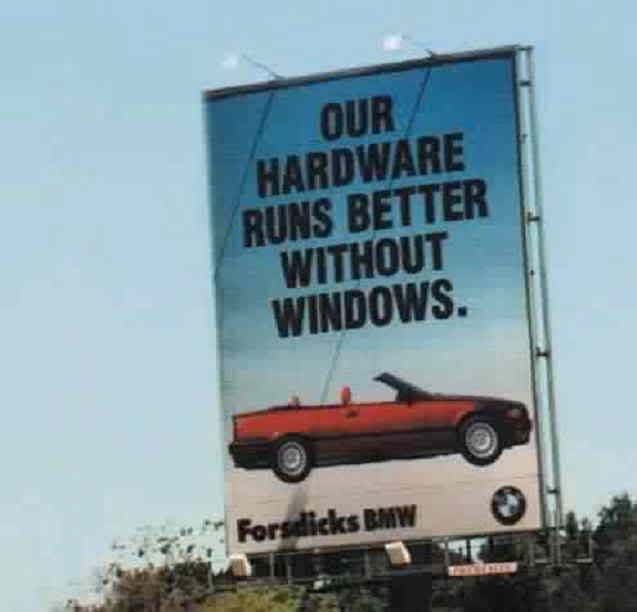 |
 LXer Feature: 27-May-2013
Comments (6)
This is a major problem. Who is going to organize and oversee all this? I'm sure more than jes the auto industry is reluctant to become involved. It's one thing when 2 cars collide and and it has to be sorted out, but quite another if there's a system wide failure where several hundred cars are involved, all different auto brands and no doubt different software brands. Or is Google gonna own it all? I doubt it. And how WILL the govt regulate such a sticky nightmare. I don't see it happening for way longer than I'll be sucking oxy moles on this orb.
Also, despite M$'s impossible software, I find their hardware to be excellent. I've got two M$ keyboards and a trackball mouse and they're nearly bullet-proof. I wish their software was one-tenth as good. ;)
Also, despite M$'s impossible software, I find their hardware to be excellent. I've got two M$ keyboards and a trackball mouse and they're nearly bullet-proof. I wish their software was one-tenth as good. ;)
I thought this page is appropriately related to the subject: GM replies to Bill Gates
And this goodie for a Dancing CEO
Heck, why not more goodies for Memorial day!
And this goodie for a Dancing CEO
Heck, why not more goodies for Memorial day!
EULA doesn't matter that much.
BMW can sell you a car with an EULA which says if BMW made a mistake with your brakes and you have an accident, BMW isn't liable. But the law prevails.
In fact, Apple did sell devices with an EULA which says you only have right to 1 year of guarentee, but judges all over Europe are making minced meat of Apple's EULA.
That's why MS hardware is bullet proof: Depending on country and interpretation of the judge, a mouse has to work for in between 2 and 5 years.
Thing is, there are laws for guarentee and for product liability, but not for software. That's why Google, MS or Apple can make EULA's in first place. Until society becomes dependent on it and politicians intervene: Soon, banks might have to pay if some hackers DDOS the hack out of internet-banking, and if such a thing happens, banks will probably be actually willing to have robust software, and they might even push to shut down "Windows zombie networks". In a distorted way, one would almost believe that banks might help society; at least against Windows-zombie boxes (but also cracked Apache/Linux servers) that is.
Microsoft's EULA for their software is little more than, "We get all the credit if it works, and none of the blame if it breaks. Oh, and we get to define 'works' and 'breaks'. Oh yeah, one more thing: By reading this, you have agreed to it."
And if their software does "break" even by their own definition, the maximum compensation to the customer will be about $5 (ie. cost of media).
Post a comment
A free account is needed to post. Write your comment here first: your text is kept in this browser while you sign up or log in, and is waiting for you when you come back.
Your message:Markdown: **bold**, *italic*, [text](https://link), - lists, > quotes, $x^2$ for math. Formatting help
Sign up and post (it is free) or Log in and post

|
|
I honestly don't think any sane person would buy a car manufactured by MS, their reputation for reliability is not that high.